
Design and Simulation of a 4-DoF Manipulator for Pick-and-Place Using Cubic Trajectories and Numerical IK
Implemented a Simulink architecture that integrates cubic spline trajectory interpolation to generate smooth, continuously differentiable paths through user-defined waypoints, state machine waypoint tracking logic to advance only when the end-effector reaches a waypoint within a defined tolerance, forward + inverse kinematics (numerical IK) to map between Cartesian targets and joint configurations, and gripper torque feedback to detect whether the object is actually grasped before proceeding.
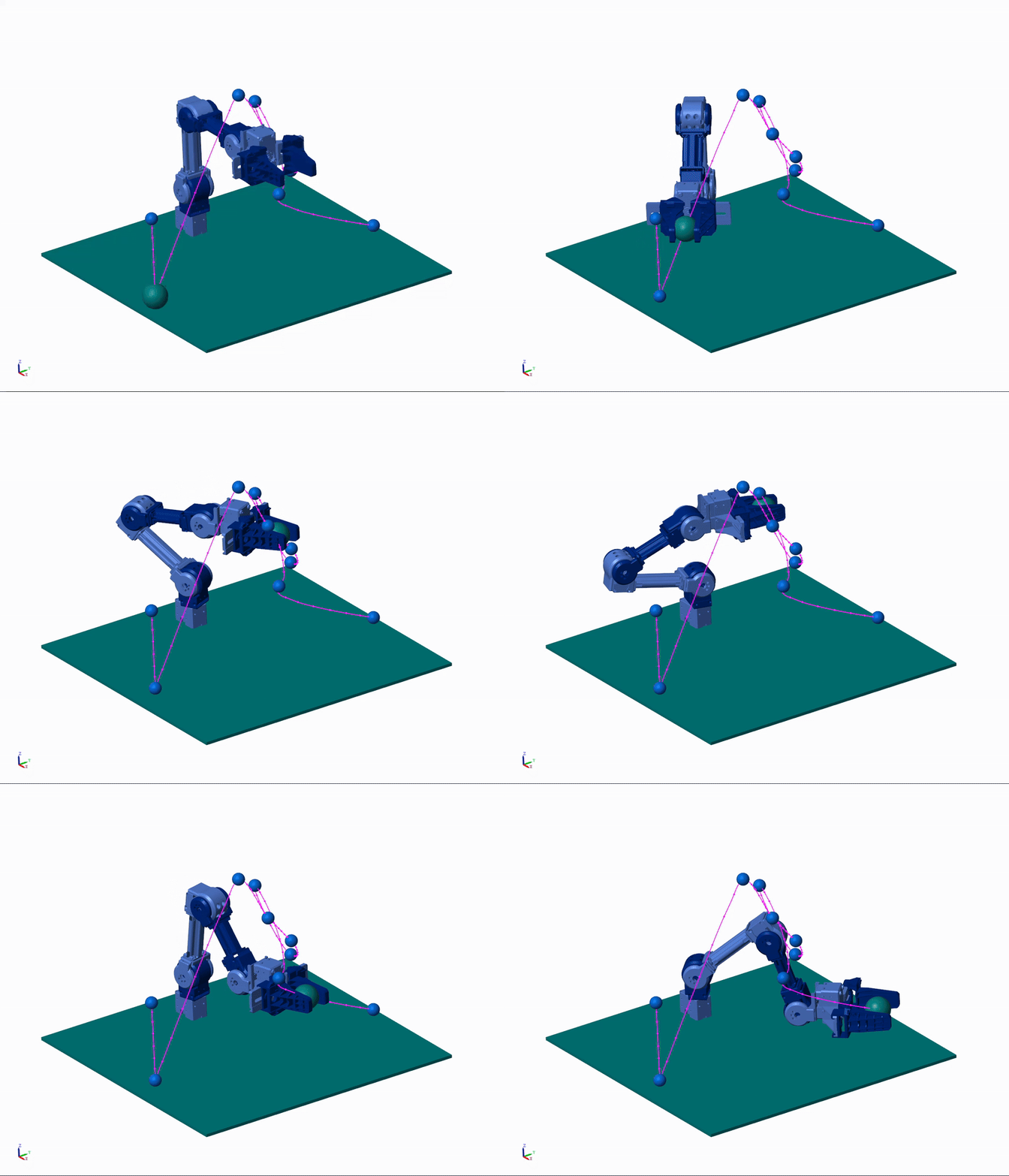
4-DoF Manipulator Pick-and-Place Simulation
🎯Problem
Pick-and-place seems simple, but getting a manipulator to move smoothly and repeatably through a 3D workspace requires multiple subsystems to work together: trajectory planning, kinematics, waypoint logic, and grasp verification. The goal was to build a clear, modular simulation pipeline that could (1) follow a complex path, (2) hit waypoints within tolerance, and (3) confirm grasp success using feedback instead of assumptions.
Smooth trajectory generation (cubic interpolation) dramatically improves stability and realism compared to piecewise linear paths.
State-machine waypoint logic is a clean way to enforce correctness and sequencing in manipulation tasks.
Feedback (gripper torque sensing) is essential—'commanded close' is not the same as 'object secured.'
💡Solution
Cubic spline trajectory interpolation to generate a smooth, continuously differentiable path through user-defined waypoints.
State machine waypoint tracking logic to advance only when the end-effector reaches a waypoint within a defined tolerance.
Forward + inverse kinematics (numerical IK) to map between Cartesian targets and joint configurations.
Gripper torque feedback to detect whether the object is actually grasped before proceeding.
Modular subsystem design: trajectory → tracking logic → kinematics → visualization/environment.
⚡Key Features
- 4-DoF manipulator model configured and simulated in MATLAB/Simulink.
- Cubic spline interpolation for smooth trajectories and motion realism.
- Tolerance-gated waypoint progression via Stateflow for deterministic sequencing.
- Numerical IK to compute joint angles for target end-effector positions.
- Gripper feedback loop using torque sensing to confirm grasp success.
✅Validation
- Verified the manipulator follows the planned trajectory while maintaining smooth motion profiles enabled by cubic interpolation.
- Validated waypoint tracking by enforcing a tolerance check before advancing to the next waypoint (State machine gating).
- Confirmed grasp detection using torque feedback from the gripper to ensure the object is secured before continuing.
📊Results
🔧Challenges
- Numerical IK can be sensitive near singular configurations; convergence behavior depends on step size, tolerance, and initial conditions.
- Choosing tolerance values that preserve accuracy without causing 'stalling' at waypoints required iterative tuning.
- Grasp detection needed a reliable threshold/logic so the pipeline doesn't advance without a confirmed grasp.
🎓Takeaways
- Smooth trajectory generation (cubic interpolation) dramatically improves stability and realism compared to piecewise linear paths.
- State-machine waypoint logic is a clean way to enforce correctness and sequencing in manipulation tasks.
- Feedback (gripper torque sensing) is essential—'commanded close' is not the same as 'object secured.'
Want to learn more about this project?
I'm happy to discuss the technical details, challenges, and learnings from this work.