
Vehicle-to-Everything (V2X) for Emergency Vehicle Priority — Comprehensive Review
Produced a structured review of the V2X ecosystem for emergency vehicle prioritization, including historical evolution of preemption and V2X adoption trends, core communication types used for EVP (V2I, V2V, V2P), deployment constraints (signal degradation, channel congestion, interoperability, security/authentication, reliability), and forward-looking pathways (C-V2X/5G → 6G, AI coordination, Li-Fi, and sensor fusion).
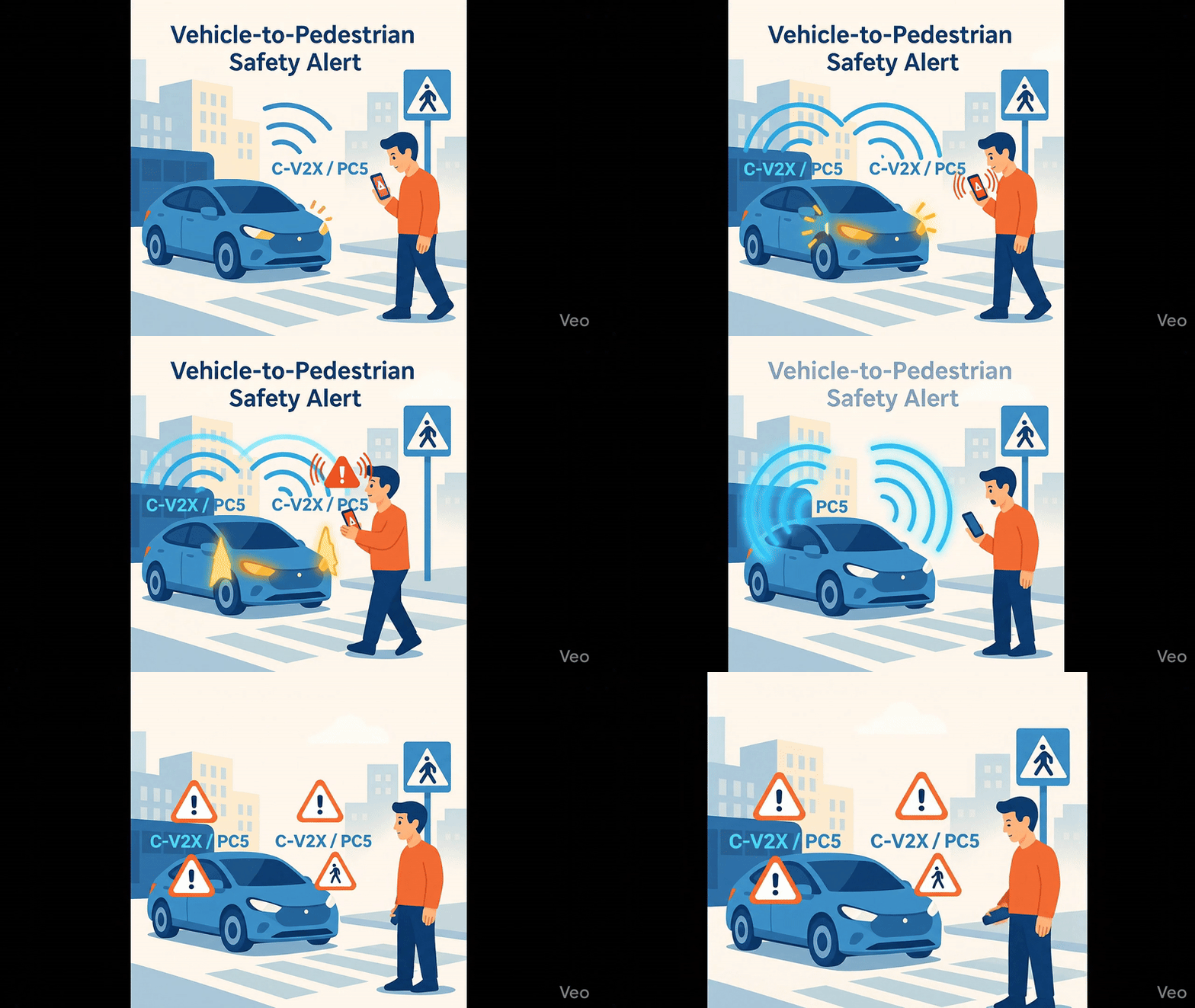
V2X Emergency Vehicle Priority Overview
🎯Problem
Emergency response time is life-critical, but urban congestion increasingly delays emergency vehicles. The paper highlights typical peak-hour delays of 4–6 minutes, and notes that every additional minute of EMS response time can reduce survival likelihood by ~6% in out-of-hospital cardiac arrest scenarios. Traditional traffic preemption helps, but older 'line-of-sight' approaches (strobe/IR/acoustic) can fail due to interference and obstructions.
EVP systems must move from isolated preemption toward an integrated V2X ecosystem (V2I + V2V + V2P) to handle dense, dynamic urban traffic safely.
Future-proofing matters: designs should tolerate evolving standards, spectrum constraints, and interference through multi-modal approaches (including Li-Fi and sensor fusion).
💡Solution
Historical evolution of preemption and V2X adoption trends.
Core communication types used for EVP: V2I, V2V, V2P.
Deployment constraints: signal degradation, channel congestion, interoperability, plus security/authentication and reliability requirements.
Forward-looking pathways: C-V2X/5G → 6G, AI coordination, Li-Fi, and sensor fusion.
⚡Key Features
- Compares legacy and modern EVP approaches, including traffic signal preemption and V2X-enabled methods.
- Explains the U.S. regulatory shift shaping deployments (5.9 GHz changes, DSRC reduction, increasing push toward C-V2X).
- Highlights real deployment blockers: congestion, reliability, interoperability, security/authentication, and resilience against interference.
- Future work roadmap with practical reasoning (Li-Fi to bypass RF congestion; sensor fusion to complement limited spectrum).
✅Validation
- Synthesized and cross-referenced findings across recent academic and industry literature.
- Explicitly organized conclusions into: historical context → technologies → performance analysis → challenges → future directions.
📊Results
🔧Challenges
- RF congestion and reliability: scaling V2X adoption increases channel load and makes congestion control essential.
- Security + authentication are required for trustable emergency messages and infrastructure coordination.
- Interoperability + integration across V2I/V2V/V2P is still hard in real deployments.
- Regulatory uncertainty can reshape technical roadmaps and investments quickly.
🎓Takeaways
- EVP systems must move from isolated preemption toward an integrated V2X ecosystem (V2I + V2V + V2P) to handle dense, dynamic urban traffic safely.
- Future-proofing matters: designs should tolerate evolving standards, spectrum constraints, and interference through multi-modal approaches (including Li-Fi and sensor fusion).
Want to learn more about this project?
I'm happy to discuss the technical details, challenges, and learnings from this work.