
QPSK vs. OFDM Performance Over AWGN and Frequency-Selective Fading
Built MATLAB simulations to evaluate QPSK over AWGN (BER/SER vs SNR), OFDM (QPSK) over AWGN, and OFDM (QPSK) over frequency-selective fading including equalization, comparing results against theoretical expectations where applicable.
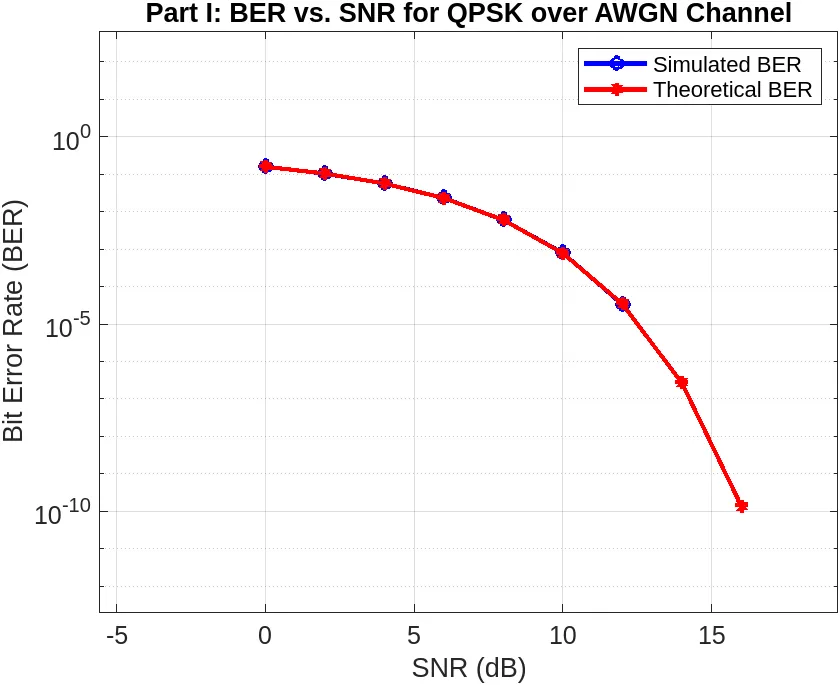
Figure 1
🎯Problem
In real wireless links, the channel is rarely 'clean.' AWGN sets the baseline, but multipath creates frequency-selective fading and ISI, which can severely degrade performance if the waveform and receiver are not designed to handle it. This project investigates how QPSK and OFDM behave across these channel conditions and where degradation comes from.
Context: MSU ECE 869 Final Project — simulation-based BER/SER performance evaluation of QPSK and OFDM across AWGN and frequency-selective fading channels.
Simulation setup: 5120 bits per run, 200 Monte Carlo runs, SNR sweep 0–16 dB (2 dB steps), OFDM N=64, CP length L=5.
💡Solution
QPSK over AWGN (BER/SER vs SNR) baseline validation.
OFDM (QPSK) over AWGN to verify OFDM implementation.
OFDM (QPSK) over frequency-selective fading with CP + FFT-domain Zero-Forcing equalization.
Comparison of simulated results against theoretical Q-function baselines.
⚡Key Features
- Gray-coded QPSK mapping to reduce bit errors (constellation mapping defined explicitly).
- OFDM chain with N = 64 subcarriers, IFFT modulation, and cyclic prefix L = 5 to mitigate ISI.
- Frequency-selective fading model using a fixed multipath impulse response h = [0.3, −0.5, 1, 0, 0.2, −0.3].
- Receiver FFT + Zero-Forcing equalization with explicit discussion of noise amplification when |Hₙ| is small.
✅Validation
- Used 200 Monte Carlo runs and averaged results to ensure statistical stability.
- QPSK-over-AWGN simulations were checked against the theoretical BER expression using the Q-function baseline.
📊Results
🔧Challenges
- Zero-Forcing equalization tradeoff: it cancels channel distortion but can amplify noise at spectral nulls / low-gain subcarriers.
- Practical next step: consider MMSE equalization for better robustness under fading.
🎓Takeaways
- OFDM's strength is structural: CP + subcarrier processing makes frequency-selective channels manageable, but equalizer choice matters.
- For fading channels, ZF is a baseline, not an endpoint—MMSE or more advanced methods can significantly improve error performance.
Want to learn more about this project?
I'm happy to discuss the technical details, challenges, and learnings from this work.